
My accountant asked me a question last tax season that I couldn’t answer cleanly: “Which of your Bitcoin gains came from the ETF and which came from your wallet?” Turns out those two piles of the same asset get treated very differently on paper, even though the price chart looks identical.
That’s the part nobody tells you when they say “just buy the ETF, it’s simpler.” It is simpler in some ways. It is not the same thing, and the differences show up exactly where you’d least want a surprise: your tax bill, your fees, and who actually controls your coins.
Quick Answer: Spot Bitcoin ETF vs Holding Bitcoin
| Factor | Spot Bitcoin ETF | Holding Bitcoin Directly |
|---|---|---|
| Ownership | You own fund shares tracking BTC price | You own the actual BTC |
| Custody | Third party custodian (usually Coinbase Custody) | Self custody or exchange, your choice |
| Typical annual fee | 0.14% to 0.25% expense ratio (up to 1.50% for GBTC) | 0% ongoing, one-time hardware wallet cost |
| Tax reporting | Simple Form 1099-B, standard capital gains | Manual cost basis tracking, Form 8949 |
| Wash sale rule | Applies, 30-day rule like stocks | Does not currently apply to direct crypto |
| Account access | Brokerage, IRA, 401(k) | Crypto exchange or self-custody wallet |
| Trading hours | US market hours only | 24/7, including weekends |
| On-chain use | Cannot spend, stake, or use in DeFi | Fully usable across wallets and protocols |
| Counterparty risk | Fund provider and custodian | None with proper self-custody |
Same Bitcoin, Two Completely Different Ownership Models
Here’s the thing that trips people up. A spot Bitcoin ETF like IBIT or FBTC isn’t a synthetic bet or a derivative. The fund actually buys real Bitcoin and locks it in institutional cold storage, almost always through Coinbase Custody, which holds the underlying coins for roughly eight of the ten major issuers. Every share you buy represents a claim on a sliver of that pool.
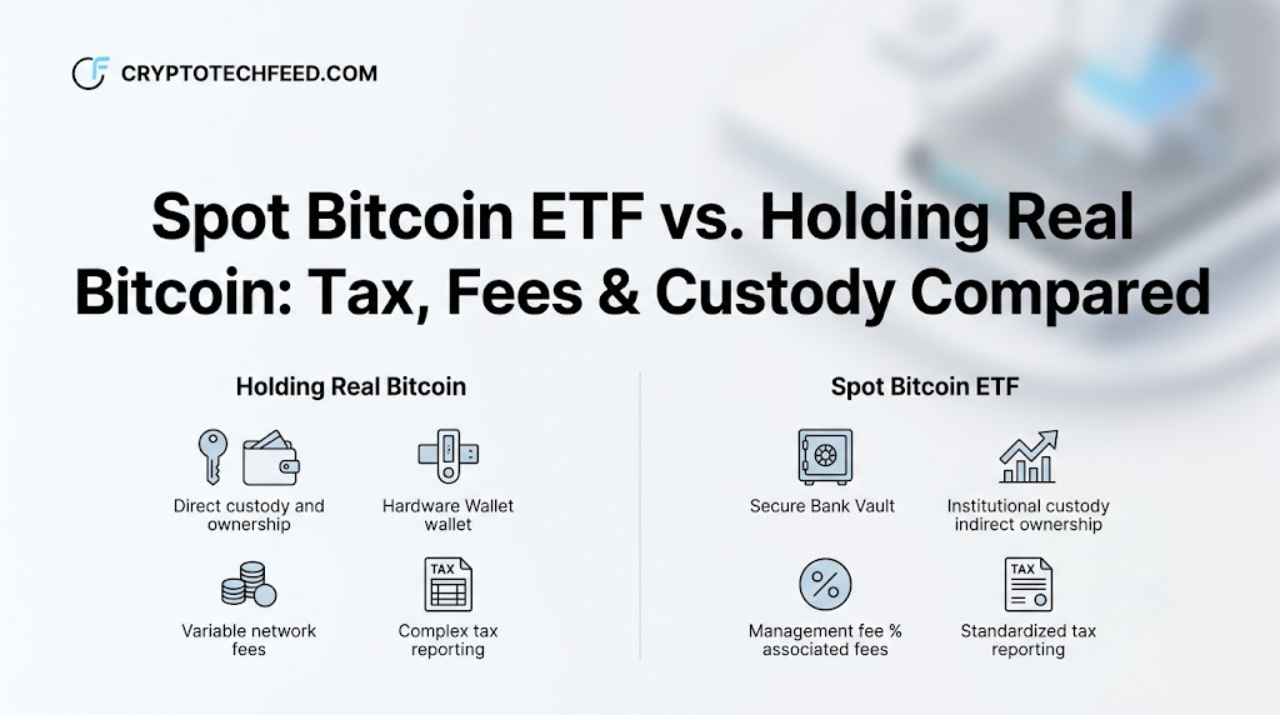
That word, claim, is doing a lot of work. You never touch a private key. You can’t move ETF shares to a hardware wallet, spend them at a merchant, or deposit them into a DeFi protocol to earn yield. What you get instead is a line item in your brokerage account that moves with Bitcoin’s price, wrapped in a legal structure your custodian and your broker both sit between you and.
Holding real Bitcoin flips that entirely. You control the private keys, or you choose an exchange that controls them for you, but either way the asset itself sits on the Bitcoin blockchain and answers to nobody but whoever holds the signing key. That’s the whole point of Bitcoin existing in the first place, and an ETF, however convenient, sits on the opposite end of that spectrum.
Spot ETF Expense Ratios: The Fee War Nobody’s Talking About
Expense ratios across spot Bitcoin ETFs dropped sharply after the initial 2024 launch wave, and by 2026 the field has split into two clear tiers. IBIT and FBTC both charge 0.25%, and together they still command the bulk of the roughly 96 billion dollar spot Bitcoin ETF market. Cheaper challengers have since undercut them meaningfully. Grayscale’s Bitcoin Mini Trust runs at 0.15%, Bitwise’s BITB sits at 0.20%, and Morgan Stanley’s newly launched MSBT claims the current low at 0.14%. Grayscale’s original GBTC, meanwhile, still charges a stubborn 1.50%, which is exactly why it keeps bleeding assets to cheaper rivals despite being the first mover.
That fee isn’t charged as a bill you pay directly. It’s deducted from the fund’s Bitcoin holdings continuously, which means your share slowly represents a shrinking fraction of a Bitcoin over time even if the price never moves. Hold an ETF charging 0.25% for ten years and, all else equal, roughly 2.5% of your position quietly evaporates into fund expenses. It’s a small number annually and an easy one to forget about precisely because nothing ever appears on a statement labeled “fee.”
Direct Bitcoin holding has no equivalent drag. Buy it, move it to a wallet you control, and there’s no recurring charge eating into your balance. Your only cost is the one-time price of a hardware wallet if you self custody, typically 60 to 250 dollars, plus network fees whenever you actually move coins, which in 2026 sit close to historic lows on a healthy mempool. Keep your Bitcoin on an exchange instead of self custodying, and you trade that fee-free structure for exchange custody risk, which brings its own kind of cost if things go wrong.
Tax Treatment: Where the ETF Actually Simplifies Things
This is genuinely the category where the ETF earns its reputation for convenience. Both spot Bitcoin ETFs and direct Bitcoin are taxed the same way at the core, capital gains on sale, short term at ordinary income rates up to 37% if held a year or less, long term at 0%, 15%, or 20% if held longer. Nobody escapes that basic structure.
Where they diverge is the paperwork underneath it. Sell ETF shares and your broker sends you a clean Form 1099-B with your cost basis already calculated, the same as selling any stock. Sell Bitcoin you’ve moved across wallets, split between exchanges, or used in a handful of transactions, and you’re often reconstructing cost basis by hand across every hop that asset took, filed on Form 8949. Anyone who’s tried to untangle a cost basis after moving BTC through three exchanges and a hardware wallet over several years knows exactly how much time that eats.
There’s one quieter difference worth flagging. ETF shares are legally securities, which means the IRS wash sale rule applies to them, the same rule that blocks you from claiming a loss if you rebuy a substantially identical position within 30 days. Direct Bitcoin currently sits outside that rule, since the IRS still classifies it as property rather than a security. That gap has let some direct holders harvest tax losses more aggressively than ETF holders can, though that’s a technicality worth confirming with a tax professional rather than a loophole to lean on blindly, since the rule could tighten.
ETFs also have a real edge inside tax-advantaged accounts. You can hold spot Bitcoin ETF shares in an IRA or 401(k) through most standard brokerages, letting gains grow tax-deferred or tax-free depending on the account type. Getting direct Bitcoin into a retirement account generally means a specialized crypto IRA custodian, an extra step most people skip entirely.
Custody: Convenience vs Control
Custody is really the philosophical center of this whole comparison. An ETF hands custody entirely to professionals. Coinbase Custody or a comparable institutional custodian holds the actual coins, subject to audits, insurance policies, and regulatory oversight that a solo self-custody setup simply doesn’t have. For someone who doesn’t want to think about seed phrases, that’s a genuine, defensible reason to choose the ETF.
But convenience there comes with layered counterparty exposure. You’re trusting the fund issuer to manage the fund honestly, the custodian to secure the coins, and the entire regulatory apparatus around both to function as intended. None of that risk disappears, it just gets professionalized and mostly invisible to you.
Direct custody removes those middle layers but hands you the responsibility instead. Self custody through a hardware wallet means nobody, not an exchange, not a fund, not a government, can freeze or seize your coins without your key. It also means if you lose that key with no backup, the coins are gone permanently, no customer support line to call. Keeping Bitcoin on an exchange without self custodying splits the difference badly, you get exchange-level convenience with a version of the ETF’s counterparty risk, minus the regulatory protections a registered fund carries.
Institutional Crypto Investing: Why ETFs Changed the Calculus
Spot Bitcoin ETFs didn’t just make Bitcoin easier for retail investors, they opened a door that used to be effectively locked for large institutions. Pension funds, endowments, and registered investment advisors generally can’t hold unregulated crypto assets directly under their mandates, but they can buy a regulated ETF through the exact same brokerage infrastructure they already use for stocks and bonds.
That shift shows up clearly in the ownership data. Institutional investors held roughly 38% of total spot Bitcoin ETF assets by the end of 2025, up from about 24% a year earlier, with investment advisors alone accounting for the largest single share of that institutional pool. That’s not retail traders chasing headlines. That’s the exact kind of allocator that moves markets slowly and stays for years, and it’s a category of buyer that direct Bitcoin holding, for structural and compliance reasons, simply couldn’t reach at the same scale.
If you’re managing money inside a mandate that restricts you to registered securities, the ETF isn’t really a choice between two similar products. It’s often the only path in the door at all.
BTC ETF Pros and Cons at a Glance
ETF advantages: simple tax reporting, IRA and 401(k) eligibility, no seed phrase risk, deep institutional liquidity, regulated custodian oversight.
ETF drawbacks: ongoing expense ratio eating into returns, no self custody, no 24/7 trading, can’t use the asset on-chain, added layers of counterparty risk.
Direct Bitcoin advantages: true ownership with self custody, zero recurring fees, 24/7 global access, full on-chain utility including spending, staking-adjacent yield, and DeFi.
Direct Bitcoin drawbacks: manual cost basis tracking, personal responsibility for key security, no built-in insurance, harder to place inside standard retirement accounts.
FAQ
Is a spot Bitcoin ETF taxed differently than holding Bitcoin? No, both are taxed as capital gains at the same short-term and long-term rates. The difference is in reporting complexity and the wash sale rule, which applies to ETF shares but not currently to direct Bitcoin.
What’s the average spot ETF expense ratio in 2026? Most major spot Bitcoin ETFs charge between 0.14% and 0.25% annually, with GBTC a notable outlier at 1.50%.
Can institutions buy Bitcoin directly instead of through an ETF? Many can’t, due to compliance mandates that restrict holdings to registered securities. That’s a major reason institutional crypto investing accelerated sharply after spot ETFs launched.
Is direct Bitcoin custody safer than an ETF? Properly executed self custody removes counterparty risk entirely, but shifts full responsibility for key security to you. An ETF trades that responsibility for professional custody and regulatory oversight.
Can I hold a Bitcoin ETF in my IRA? Yes, spot Bitcoin ETFs can typically be held in a standard IRA or 401(k) through most brokerages, while direct Bitcoin usually requires a specialized crypto IRA custodian.




