Bitcoin used to demand a wallet, a seed phrase, and a fair bit of nerve. Then in January 2024 the SEC approved eleven spot Bitcoin ETFs, and suddenly grandparents with a regular brokerage account could own Bitcoin exposure between a tech stock and a gold fund. Two and a half years later, US spot Bitcoin ETFs collectively hold tens of billions of dollars in assets, and the category has become the main entry point for new capital into Bitcoin. This guide breaks down what these funds actually are, how the machinery behind them works, and what to weigh before buying in.
What Is a Spot Bitcoin ETF
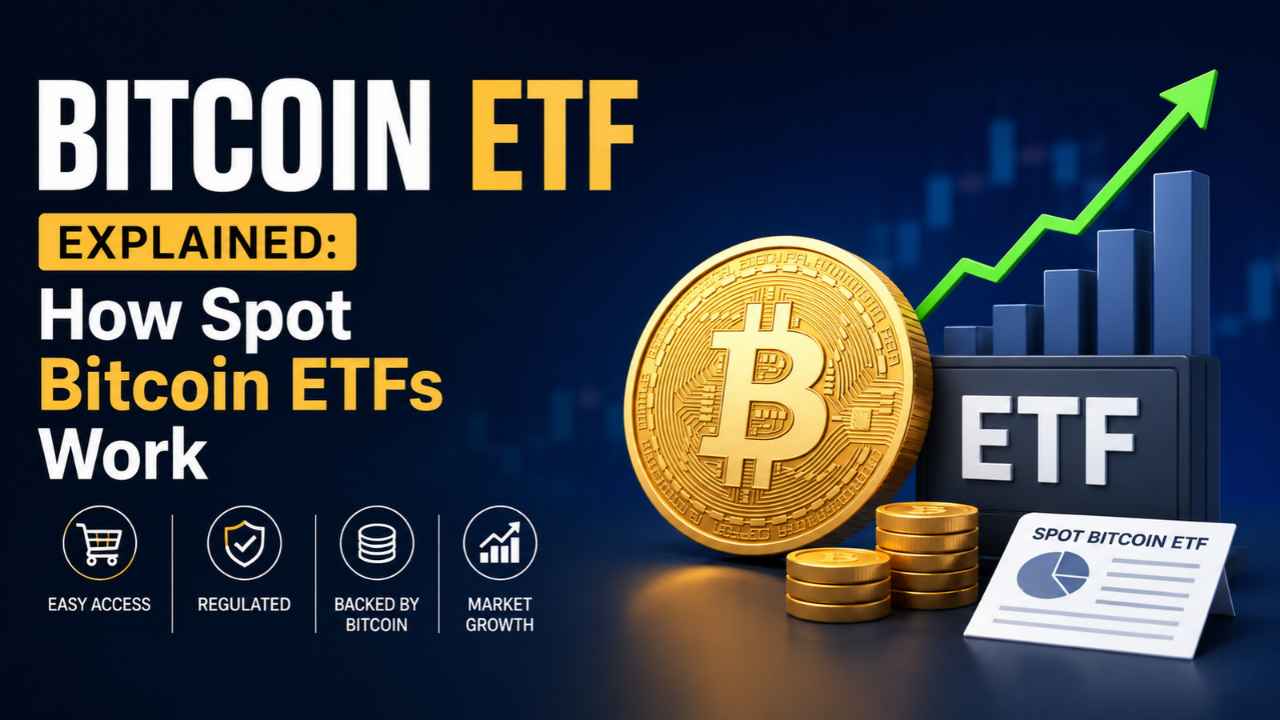
A spot Bitcoin ETF is a fund that buys and holds real Bitcoin, then issues shares that trade on a stock exchange like NYSE Arca or Cboe BZX. When you buy one share, you are not buying a derivative or a promise. You are buying a small, indirect claim on actual coins sitting in cold storage with a custodian. The fund’s share price is designed to track the spot market price of Bitcoin as closely as possible, minus fees. No crypto exchange account, no private keys, no self custody headaches.
How Spot Bitcoin ETFs Actually Work
The mechanics run through something called the creation and redemption process, and it is worth understanding because it explains why these funds track Bitcoin so tightly. Large institutional players called authorized participants deliver cash to the fund issuer, who uses it to buy Bitcoin on the open market. In exchange, the issuer creates new ETF shares for the authorized participant to sell to the public. When investors want out in bulk, the reverse happens and shares get redeemed for cash, with Bitcoin sold to match.
This constant buying and selling keeps the ETF share price anchored close to net asset value, so the fund rarely trades at a wild premium or discount to the Bitcoin it actually holds. Custody is handled by regulated third parties. BlackRock’s IBIT, for instance, stores its Bitcoin with Coinbase Custody in institutional grade cold storage, and the fund publishes its holdings and per share Bitcoin ratio daily so anyone can verify what backs their shares.
Spot Bitcoin ETF vs Bitcoin Futures ETF
People often confuse the two, so here is the difference laid out plainly.
| Feature | Spot Bitcoin ETF | Bitcoin Futures ETF |
|---|---|---|
| Underlying asset | Real Bitcoin held in custody | Futures contracts on Bitcoin |
| Price tracking | Very close to spot price | Can drift due to contract roll costs |
| Examples | IBIT, FBTC, GBTC, ARKB, BITB | BITO (ProShares) |
| Launched | January 2024 | October 2021 |
| Typical expense ratio | 0.15% to 0.25% | Around 0.95% |
| Best suited for | Long term holding | Short term tactical trades |
Futures ETFs were the only legal route to Bitcoin exposure before 2024, but the constant rolling of expiring contracts quietly eats into returns over time. Spot ETFs sidestep that problem entirely by holding the coin itself.
Who Runs the Big Bitcoin ETFs in 2026
BlackRock’s iShares Bitcoin Trust, ticker IBIT, dominates the category. Through much of 2026 it has held between roughly forty nine percent and sixty two percent of total US spot Bitcoin ETF assets, at various points sitting near fifty four billion dollars in AUM with around 777,000 BTC in custody. Fidelity’s Wise Origin Bitcoin Fund, FBTC, holds a distant second place at roughly seventeen to eighteen billion dollars. Grayscale’s GBTC still carries meaningful assets but keeps bleeding outflows because of its comparatively high 1.5% fee, pushing holders toward cheaper rivals like Bitwise’s BITB and Ark’s ARKB.
Since launch, the category has pulled in close to sixty billion dollars in cumulative net inflows, though 2026 has been choppier than 2024 was. A rough patch in May and June saw about 4.4 billion dollars exit over thirteen straight trading sessions, and the first half of the year closed with net outflows industry wide for the first time since the products debuted. Even so, IBIT alone stayed net positive across that stretch, which tells you where institutional conviction has concentrated. In March 2026, the SEC also approved options trading on spot Bitcoin ETFs, opening the door to covered call and protective put strategies for existing holders.
Benefits of Investing Through a Spot Bitcoin ETF
For most people the appeal comes down to convenience and regulation. You buy and sell through the same brokerage app you already use for stocks, the fund sits inside a familiar legal structure, and it is eligible for IRAs and other retirement accounts in the US. There is no seed phrase to lose and no exchange hack to worry about, since custody sits with regulated institutions. Liquidity is strong too. IBIT alone trades over fifty million shares a day, so entering or exiting a position rarely moves the price against you.
Risks and Limitations to Know
An ETF share is not the same thing as owning Bitcoin outright. You cannot move it to a hardware wallet, use it in DeFi, or send it peer to peer. You are trusting a custodian and a fund structure, and you pay an ongoing management fee, generally between 0.15% and 0.25% a year, that direct holders avoid entirely. Bitcoin’s underlying volatility does not disappear just because it is wrapped in a fund either. A fifty percent drawdown in Bitcoin still means a fifty percent drawdown in your ETF shares, and concentration in one or two issuers like IBIT means large outflows from a single fund can ripple through spot Bitcoin prices.
Can Indian Investors Buy Spot Bitcoin ETFs
There is no domestic spot Bitcoin ETF listed on the NSE or BSE, and SEBI has not approved one. What Indian residents can do is buy the US listed funds directly through the Reserve Bank of India’s Liberalised Remittance Scheme, which permits remittances of up to 250,000 dollars a year for permitted overseas investments including foreign securities. Platforms such as INDmoney, Vested Finance, and Mudrex let Indian investors open an international account, complete KYC, remit funds under LRS, and buy IBIT, FBTC, or similar tickers directly.
Because these are foreign equity securities and not virtual digital assets, the harsh 30% flat crypto tax and 1% TDS that apply to domestic crypto trades in India do not apply here. Instead, gains follow standard foreign asset capital gains rules, and remittances above seven lakh rupees typically attract TCS, which can later be adjusted against tax liability. It is a genuinely different tax treatment from buying Bitcoin on an Indian exchange, so it is worth checking with a tax advisor before moving large sums.
Frequently Asked Questions
What is a spot Bitcoin ETF in simple terms? It is a regulated fund that holds real Bitcoin and lets you buy shares of it on a normal stock exchange, giving you price exposure without managing a crypto wallet yourself.
Is a spot Bitcoin ETF the same as owning Bitcoin? Not exactly. You own shares backed by Bitcoin held by a custodian, but you cannot withdraw or transfer the underlying coins the way you could from a personal wallet.
Which is the biggest Bitcoin ETF in 2026? BlackRock’s IBIT remains the largest by a wide margin, holding roughly half or more of total US spot Bitcoin ETF assets through most of 2026.
Do spot Bitcoin ETFs pay dividends? No. Bitcoin does not generate yield or dividends, so these funds simply track price movement and charge an annual management fee.
Can I hold a Bitcoin ETF in a retirement account? In the US, spot Bitcoin ETFs are generally eligible for IRAs and similar retirement accounts, unlike direct crypto holdings on most platforms.
Is there an Indian spot Bitcoin ETF on NSE or BSE? No. As of 2026, SEBI has not approved a domestic Bitcoin ETF, and Indian residents must use the LRS route to access US listed funds instead.
What is the difference between IBIT and GBTC? Both hold real Bitcoin, but IBIT charges a 0.25% fee against GBTC’s much higher 1.5%, which is why GBTC has seen persistent outflows since 2024.
Sources: BlackRock iShares IBIT fact sheet, The Block ETF data tracker, SoSoValue flow data, CoinGlass Bitcoin ETF dashboard, Reserve Bank of India LRS guidelines.