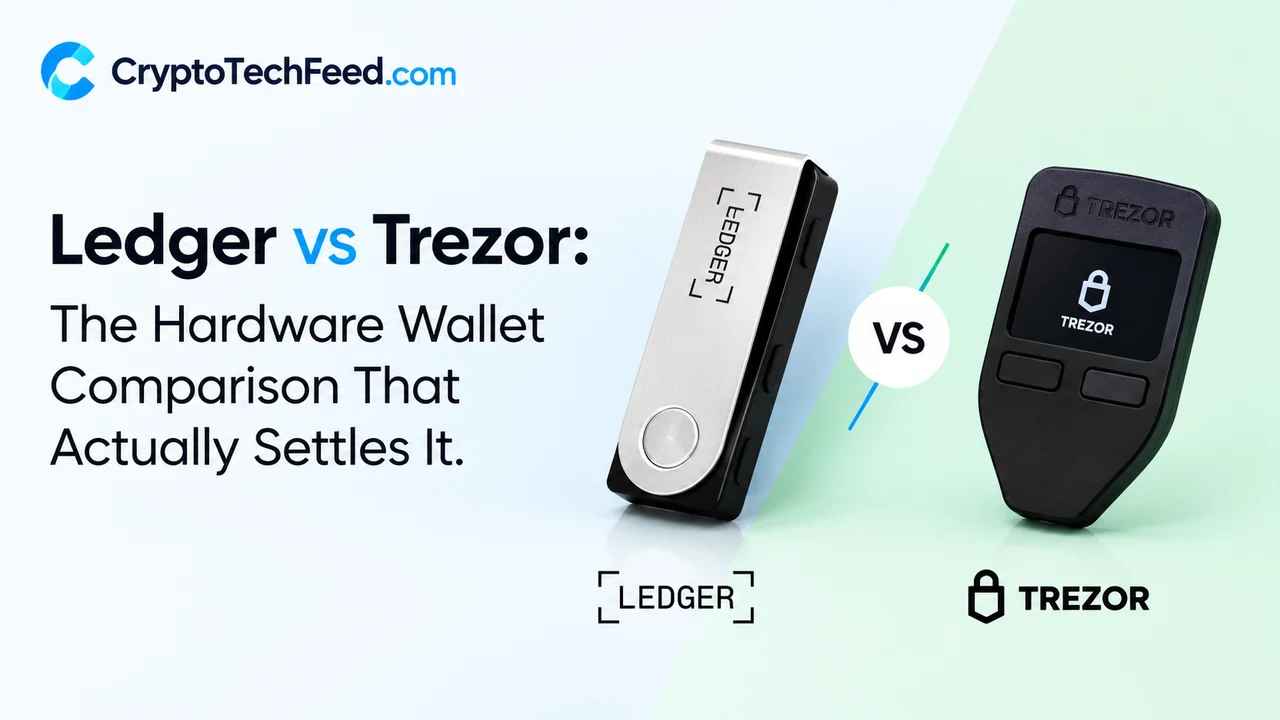
If you have more than a few hundred dollars sitting on an exchange right now, you already know the uncomfortable truth. That balance is a number on someone else’s server, not coins you control. Moving it into cold storage is the obvious fix, and the moment you start researching how, two names dominate every search result: Ledger and Trezor. Both have been building hardware wallets since the early days of Bitcoin, both have sold millions of units, and both had a rough year on the security front in 2026. This guide breaks down the ledger vs trezor hardware wallet comparison the way an analyst would, not the way a marketing page would, so you can pick the device that actually matches your risk profile instead of the one with the louder ad budget.
Quick Verdict Before the Deep Dive
- Choose Ledger if you want the broadest coin support, Bluetooth mobile access through Ledger Live, and a certified secure element chip.
- Choose Trezor if open source firmware, full code transparency, and Shamir backup matter more to you than ecosystem polish.
- Both are cold storage devices, meaning your private keys never touch the internet. Either one puts you miles ahead of leaving funds on an exchange.
What You’re Actually Buying With a Hardware Wallet
A hardware wallet is not a bank vault and it does not hold your coins inside it. What it holds is your private key, generated and stored on a chip that never exposes that key to your phone, your laptop, or the internet. Every transaction gets signed inside the device itself, and you confirm the details on its physical screen before anything moves. That single design choice is what separates cold storage from a software wallet sitting on an internet connected phone. The real decision in the ledger vs trezor hardware wallet comparison is not whether one holds coins better than the other. It is which security philosophy and software ecosystem fits how you actually plan to use your crypto day to day.
Ledger’s 2026 Lineup
Ledger is a French company and the best selling hardware wallet brand in the world, with over 7 million devices shipped across more than 200 countries. Its current range spans an entry level device up to a premium touchscreen model built for people who want their wallet to feel like a piece of consumer electronics rather than a USB stick.
- Nano S Plus ($79): entry level, USB only, no Bluetooth, supports over 5,500 coins and tokens through Ledger Live.
- Nano X ($149): adds Bluetooth for mobile use and a larger coin storage capacity on device.
- Ledger Flex (mid premium): touchscreen, E Ink style display, NFC and Bluetooth pairing.
- Ledger Stax ($279): flagship, curved E Ink touchscreen, customizable lock screen, the most phone like experience of the lineup.
Every Ledger device runs on a certified secure element chip, the same category of hardware used in passports and payment cards, and the firmware itself is closed source. Ledger argues this closed model prevents attackers from studying the code for exploits. Critics argue it asks users to trust the company rather than verify the claim themselves.
Trezor’s 2026 Lineup
Trezor, built by the Czech company SatoshiLabs, holds the title of the first hardware wallet ever brought to market, back in 2013. Its entire brand is built on transparency: every line of firmware is open source and sits on GitHub for anyone to audit. That philosophy has not changed even as the hardware has gotten more capable.
- Trezor Safe 3 ($79): the budget entry point, open source firmware, supports BIP39 and Shamir backup (SLIP39).
- Trezor Safe 5: adds a color touchscreen and a secure element chip while keeping the firmware auditable.
- Trezor Safe 7: the newest flagship, the first Trezor with Bluetooth, built around the Tropic01 secure element that SatoshiLabs describes as transparent and independently auditable rather than a black box.
- Trezor Model One and Model T have been phased out of the current lineup but remain supported for existing owners.
Where Ledger leans on certification and a closed chip, Trezor has spent a decade trying to prove that open code and hardware security are not mutually exclusive.
Security Architecture: Secure Element vs Open Source
This is the philosophical core of the ledger vs trezor hardware wallet comparison, and neither side is simply right. Ledger’s secure element chips carry Common Criteria certification, the same standard banks rely on, and that certification process is independently verified even if the underlying code stays private. Trezor’s counterargument is that a closed chip asks you to trust a vendor’s claims on faith, while open firmware lets security researchers find and report flaws before attackers do.
Points that matter in practice:
- Ledger’s secure element resists physical extraction attacks, including chip decapping, at a level independently tested labs have confirmed.
- Trezor’s classic Safe 3 uses a general purpose chip by design, a deliberate open source tradeoff, while the newer Safe 5 and Safe 7 add a certified secure element without closing the firmware.
- Both brands require you to confirm every transaction on the device’s own screen, which blocks the most common clipboard hijacking and malware based attacks.
- Neither wallet has ever had funds stolen directly off the device itself through a confirmed firmware exploit. The incidents in both companies’ history have come from phishing, fake apps, and supply chain weak points, not broken chips.
The 2026 Breaches Both Companies Had
Worth being honest about, since most comparison pages skip it. In 2026, Trezor disclosed that ShipMonk, one of its third party shipping providers, suffered a breach through a vulnerability in an analytics tool, exposing customer shipping data. Around the same period, Ledger’s payment processor Global-e was also compromised, exposing additional customer information from past orders. In both cases, the breach hit a vendor handling logistics or payments, not the hardware wallet’s firmware or secure element. No funds were drained from either company’s devices as a direct result. The real risk from these incidents is phishing: attackers now hold real names and addresses of confirmed hardware wallet owners, and fake “your device is compromised, enter your seed phrase here” scams have followed both leaks. If you own either brand, that is the threat to actually watch for, not a flaw in the hardware itself.
Price and Value Comparison
| Model | Price | Bluetooth | Touchscreen | Open Source |
|---|---|---|---|---|
| Trezor Safe 3 | $79 | No | No | Yes |
| Ledger Nano S Plus | $79 | No | No | No |
| Ledger Nano X | $149 | Yes | No | No |
| Trezor Safe 5 | ~$169 | No | Yes | Partial |
| Ledger Flex | ~$199 | Yes | Yes | No |
| Trezor Safe 7 | ~$219 | Yes | Yes | Partial |
| Ledger Stax | $279 | Yes | Yes | No |
At the entry level, pricing is nearly identical between the Safe 3 and the Nano S Plus, so cost alone will not make this decision for you. The gap widens at the premium end, where Ledger’s Stax and Flex charge for industrial design as much as for function. If budget is the deciding factor and you mainly hold Bitcoin, the Safe 3 is hard to beat. If you want the most coins supported per dollar spent, the Nano S Plus edges ahead.
Coin Support and Software Ecosystem
Ledger Live supports well over 5,500 coins and tokens natively, including staking for assets like Ethereum and Solana directly inside the app, plus a built in NFT gallery and swap feature. Trezor Suite covers roughly 1,000 to 1,500 assets out of the box, with excellent native Bitcoin tooling including coin control and CoinJoin integration, but chains like Solana generally require pairing with a third party wallet such as MetaMask or Rabby to function. For a Bitcoin maximalist, Trezor’s native tooling is arguably more refined. For an active multi chain holder who wants one app to manage everything, Ledger Live remains the more complete ecosystem.
Ease of Setup and Daily Use
Both devices walk you through the same core ritual: generate a new seed phrase, write it down on paper or steel, confirm it on device, then install the apps for whichever coins you hold. Ledger’s Stax and Flex feel closer to using a smartphone, with a touchscreen and app icons you can rearrange. Trezor Suite runs primarily as a desktop and browser based app, which some users find more deliberate and less distracting than a mobile first workflow. Neither company makes you choose between security and usability anymore, that tradeoff mostly disappeared once Trezor added touchscreens and Ledger added Bluetooth. The bigger daily use difference now is simply desktop centric versus mobile centric, and that comes down to personal habit more than security.
Which One Should You Actually Buy
- New to crypto, holding mostly Bitcoin and Ethereum: Trezor Safe 3 or Ledger Nano S Plus. Nearly identical price, pick based on whether you value open firmware or broader altcoin support.
- Active trader across many chains, wants staking and NFTs in one app: Ledger Nano X or Flex, for the Ledger Live ecosystem.
- Bitcoin only, values auditability above all else: Trezor Safe 3 or Safe 5, paired with Shamir backup for inheritance planning.
- Wants the most premium, phone like experience and does not mind a closed chip: Ledger Stax.
- Wants Bluetooth plus open firmware together: Trezor Safe 7, currently the only device offering both.
Frequently Asked Questions
Is Ledger or Trezor safer in 2026? Both block remote key extraction when used correctly. Ledger relies on a certified closed secure element, Trezor relies on open source code you can audit yourself, with newer Safe models adding their own secure element on top. Neither has had a confirmed firmware level fund theft.
Can my Ledger or Trezor seed phrase work on the other brand? Yes, as long as it is a standard BIP39 phrase. Trezor’s Shamir backup format (SLIP39) is Trezor specific and will not import directly into a Ledger device.
Does Trezor support Solana and other newer chains? Not natively in most cases. You will need to pair Trezor with a third party wallet like MetaMask or Rabby for chains like Solana, while Ledger Live supports Solana staking directly.
Were any funds stolen in the 2026 Ledger or Trezor breaches? No. Both 2026 incidents exposed customer shipping or payment data through third party vendors. Neither breach compromised the devices’ firmware or secure element directly, but both increased phishing risk for confirmed owners.
Which hardware wallet is better for beginners? Ledger’s app based setup with Ledger Live is generally considered more guided for first time users. Trezor’s setup is equally secure but leans slightly more technical in its desktop workflow.
Do I need Bluetooth on a hardware wallet? No, and some security minded users deliberately avoid it. Bluetooth adds convenience for mobile management but also adds a wireless attack surface that a wired USB only device like the Nano S Plus or Safe 3 simply does not have.
Related Reading
- 6 Best Hardware Wallets Ranked for 2026
- Hot Wallet vs Cold Wallet: What’s the Real Difference
- How to Set Up a Hardware Wallet Step by Step
- How to Back Up a Hardware Wallet Without Losing Everything
- Best Multisig Wallets for Teams and DAOs in 2026