
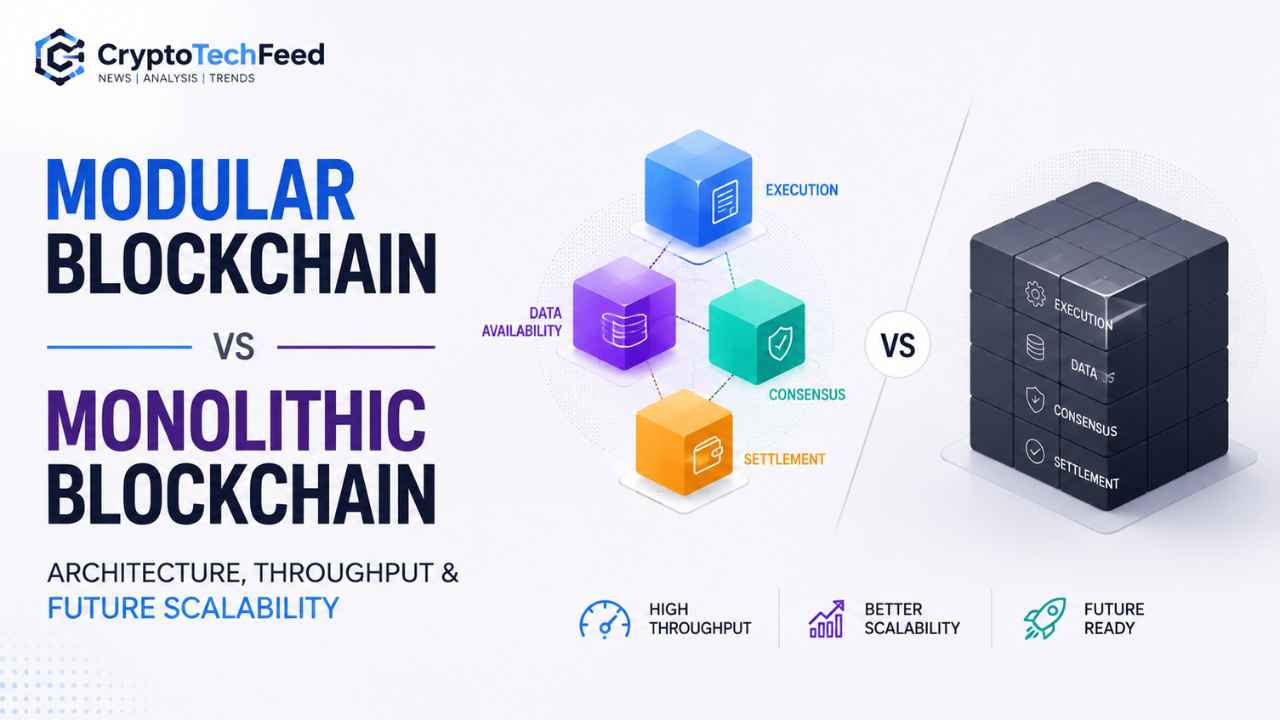
A developer friend called me last month, torn between two roadmaps. Build his app on Solana and get raw speed from day one, or launch a rollup on Celestia and inherit modular flexibility instead. That single phone call sums up where crypto infrastructure stands right now. Modular blockchain vs monolithic architecture is not a niche debate anymore. It decides how fast a chain settles, how much a transaction costs, and how far a network can grow before it buckles. This piece breaks down both models honestly, with real numbers, so you understand which direction the industry is heading in.
What Monolithic Blockchain Architecture Actually Means
Monolithic blockchain architecture keeps every job on one chain. Consensus, execution, settlement, and data availability all run through a single validator set. Ethereum before rollups worked this way. Solana still does. Nothing gets outsourced. Every node downloads the full history and verifies every transaction itself. That design keeps things simple and highly secure, since one unified set of rules governs the entire network. But it also means the whole system moves only as fast as its slowest component. When usage spikes, blockspace gets scarce, fees jump, and the chain either upgrades hardware requirements or accepts congestion as a permanent feature.
Complete Crypto Guide
Solana and the Case for Monolithic Design
Solana is the clearest modern example of monolithic design done aggressively. Real world throughput sits around one thousand to four thousand transactions per second under normal conditions, with block times near four hundred milliseconds. Ethereum mainnet by comparison processes roughly fifteen to twenty four transactions per second on its base layer. Solana proves monolithic chains can scale hardware and parallel execution far past early expectations. The tradeoff shows up in validator requirements. Running a competitive Solana node needs serious bandwidth and storage, which slowly narrows who can actually participate in consensus at the highest performance tier.
What Modular Blockchain Architecture Changes
Modular blockchain design splits those same jobs across specialized layers instead of forcing one chain to do everything. Execution happens on a rollup. Data availability moves to a dedicated layer built purely for that job. Settlement anchors somewhere secure, often Ethereum. Consensus can live separately too. Each layer competes on its own terms and improves independently, without waiting on the others to catch up. This is the core answer to the modular blockchain vs monolithic question. Instead of one chain trying to be everything at once, specialized layers each get really good at a single narrow task.
Modular Execution Layers Explained
Modular execution layers are where users actually interact with an application. Think of a rollup as a fast lane that bundles transactions off the main chain, executes them, then posts a compressed proof back to a settlement layer. Because execution is separated from data publishing, developers can spin up an app specific chain without inheriting the full weight of consensus. Arbitrum, Optimism, and Base all run this way today. The result is execution environments tuned for gaming, payments, or trading, each optimized for its own workload rather than sharing one generic chain with unrelated applications.
Celestia Modular Stack: Proof the Model Works
Celestia is the clearest proof that modular architecture works outside a whitepaper. The celestia modular stack strips away execution entirely and focuses only on consensus and data availability, the part of a rollup’s job that used to eat up to ninety five percent of its costs. By mid twenty twenty five, Celestia was serving fifty six plus live rollups and had processed over one hundred sixty gigabytes of rollup data, capturing roughly half the data availability market. Its January twenty twenty six Matcha upgrade pushed block capacity to one hundred twenty eight megabytes while cutting node storage seventy seven percent.
Data Availability and the Cost War Nobody Talks About
Data availability sounds technical but the idea is simple. Rollups need somewhere cheap and trustworthy to publish transaction data so anyone can verify the chain later. Celestia prices that at roughly zero point zero zero one dollars per megabyte, undercutting posting data directly on Ethereum. That price gap triggered a real fee war. A typical layer two transaction that cost around fifty cents in late twenty twenty five now runs between twenty and thirty cents after recent upgrades on both sides. EigenDA and Avail are chasing the same market, each betting on a different tradeoff between speed and trust.
Modular Blockchain vs Monolithic: Throughput Compared
Throughput comparisons between the two models rarely tell the full story on their own. Solana’s real numbers, around one to four thousand transactions per second, look modest next to Celestia’s experimental Fibre Blockspace protocol, which targets throughput in the terabit per second range for raw data publishing. But these are not measuring the same thing. Monolithic throughput counts full transaction execution end to end. Modular throughput often measures data capacity across dozens of rollups running in parallel. A fairer comparison looks at total ecosystem capacity, where modular stacks can theoretically scale horizontally simply by adding more rollups.
Security Tradeoffs Between the Two Models
Security tradeoffs deserve equal attention here. Monolithic chains offer one unified trust assumption. If you trust Solana’s validator set, you trust every transaction on it, full stop. Modular systems split trust across layers, which introduces new failure points but also new flexibility. A rollup inherits security from wherever it settles, while data availability gets guaranteed separately through sampling techniques that let light nodes verify huge datasets without downloading everything. EigenDA takes a different route, using a data availability committee model instead of a fully public verification system, trading some decentralization for higher raw throughput.
Real Deployments: Who Is Actually Using What
Real deployments make this less abstract. Arbitrum Orbit, the OP Stack, and Polygon CDK now all support Celestia as a standard data availability backend, alongside their default settlement paths. Fuel is building a modular execution layer optimized purely for parallel transaction processing. Meanwhile Solana keeps proving that a monolithic chain, if engineered aggressively enough, can still outperform most modular stacks on raw user facing speed. Neither camp has fully won. Builders increasingly choose based on what their specific application actually needs, rather than picking a side in an ideological argument between modular and monolithic purity.
Future Scalability: Which Model Wins
Future scalability probably does not belong entirely to one model. Ethereum itself is proof of that. It started fully monolithic, hit real limits under demand, and gradually modularized by pushing execution to rollups while keeping settlement and eventually data availability more flexible through blob space. Monolithic chains like Solana will keep pushing hardware and parallel execution further, because that ceiling has not been reached yet either. The likely outcome is a layered internet of blockchains, where modular execution layers, dedicated data availability networks, and high throughput monolithic chains each serve workloads suited to their specific strengths.
What This Means If You Are Investing or Building
So which one should you actually care about as an investor or a builder. If you are evaluating a project, ask where it sits on this spectrum and why. A modular rollup betting everything on cheap data availability lives or dies by its chosen data layer’s uptime and pricing. A monolithic chain betting on raw speed lives or dies by validator decentralization holding up under growth. Neither answer is universally correct. What matters is understanding the tradeoff a project has actually made, because that tradeoff quietly shapes everything else about how it performs later.
Modular vs Monolithic at a Glance
| Factor | Monolithic Blockchain | Modular Blockchain |
|---|---|---|
| Core Idea | One chain runs consensus, execution, settlement, and data availability | Each job is split across dedicated specialized layers |
| Example | Solana | Celestia plus rollups such as Arbitrum, Optimism, Base |
| Real World Throughput | Roughly 1,000 to 4,000 TPS | Varies by rollup, data layer capacity scaling toward terabit range |
| Node Requirement | High bandwidth and storage for full validation | Lighter for most layers, sampling reduces node burden |
| Trust Model | One unified validator set | Trust split across execution, settlement, and data layers |
| Cost Trend | Fees rise with congestion on one chain | Data availability fee wars are pushing rollup costs down |
| Best Fit For | Apps needing single layer speed and simplicity | Apps needing app specific chains and flexible scaling |
Frequently Asked Questions
What is the main difference in modular blockchain vs monolithic design? A monolithic chain handles consensus, execution, settlement, and data availability on one layer. A modular blockchain splits those jobs across separate layers that improve independently.
Is Celestia a blockchain or a data availability layer? Celestia runs consensus and focuses purely on data availability. It does not execute smart contracts. Rollups post their transaction data to Celestia while handling execution themselves.
Why is monolithic blockchain architecture still popular if modular is newer? Because it keeps things simple and fast for users. Solana proves a single chain can push very high throughput through parallel execution rather than splitting the workload.
What are modular execution layers used for? They handle the actual computation for an application, similar to how a rollup processes transactions before posting proofs back to a settlement or data availability layer.
Will modular blockchains eventually replace monolithic chains completely? Unlikely. Both models are improving in parallel. Ethereum modularized after hitting limits, while Solana keeps scaling as a monolithic chain, suggesting the future holds both approaches.
Which model is cheaper for developers to build on? Modular stacks are generally cheaper for launching a new chain, since data availability layers like Celestia charge far less than posting data directly on a monolithic settlement chain.